


At October’s Mount Holly Council meeting, Nathan Roseboro of “Voter Choice NJ” urged Council to support “Ranked Choice Voting” [RCV]. RCV is a system that guarantees a 50%+ majority will be achieved by a candidate in a single ballot. Mount Holly’s current election system is a “one and done” ballot that recently produced “winners” who were opposed by more than 50% of voters. This can happen any time three or more candidates vie for a single Mount Holly office.
But on November 4th, voters approved an electoral remedy for this problem when the ballot question about run-off elections won by a large margin. This is a victory for small “d” democracy but it does come at a cost. Run-off elections cost additional money and require voters to vote a second time.
While RCV requires no additional cost and no new ballot, it cannot be adopted here because the New Jersey legislature has not seen fit to make ranked choice voting legal. And so an effort is underway to convince our legislature that RCV should be made legal. There has been progress recently, but the going is tough, especially right here in Mount Holly, where the Mayor and Deputy Mayor will not meet to discuss the the issue with Mr. Roseboro. See article below.
https://www.themounthollyreporter.org/p/council-member-astor-speaks-out
Why is it such tough going? Articles on the subject say its because many elected officials fear the leveling of the political playing field between incumbents and newcomers.
Those who believe ranked choice voting reduces the power of incumbency would point to the following factors:
It allows voters to express preferences for more than one candidate by allowing “ranked” votes between the candidates [#1 preference, #2 preference and so on].
This eliminates voter fear of “wasting” a ballot on a new candidate that is thought to be more likely to lose, thereby encouraging support for newcomers.
A positive feedback loop is created that promotes a diverse field of candidates and greater voter interest.
The larger field tends to spread out the distribution of “#1 preference” votes, thereby reducing the benefit of incumbency.

As Mr. Roseboro’s draft resolution was handed to Clerk Sherry Marnell, a number of residents wondered if the Mayor and Township Manager would allow the resolution to appear on a future council meeting agenda. Since council members Tara Astor and Kim Burkus are known to support the concept, bringing the resolution to the floor would only require one vote from the remaining three members to pass it. If that occurs, Mount Holly would be the tenth municipality in the state to send a Resolution of Support for RCV to the New Jersey Legislature.
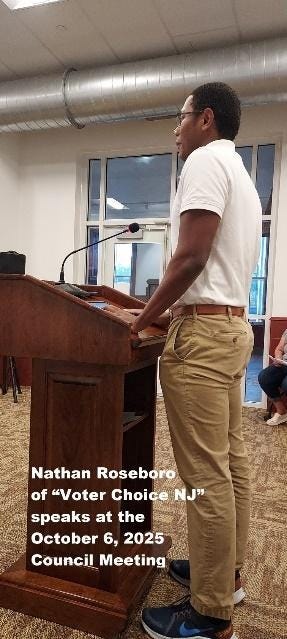
“I submitted a sample resolution to [Town Clerk] Sherry on Thursday” [Oct 2nd], but that resolution missed a deadline for the October meeting. “That’s fine”, said Astor, “its better to allow everyone time to digest the information. No need to rush.”
The resolution is a non-binding document and Astor said that “the non-binding resolution would be easier to pass than a binding ordinance. It just lets the state legislature know that there is one more town in support of RCV.”
As can be seen on the Voter Choice NJ graphic below, the number of municipalities in support of RCV has been enjoyed growth over the last two years.
Roseboro said that “The Municipal & School Board Voting Options Act, introduced in the Senate by Senators Andrew Zwicker and Linda Greenstein, and in the Assembly by Assemblyman John Allen, would allow Municipalities and Schools the option to use Ranked Choice Voting in their elections. The assembly bill is A4042 (John Allen, Jessica Ramirez, Barba McCann Stamato and Garnet Hall) and the senate bill is S1622 (Andrew Zwicker, Linda Greenstein, Shirley Turner, Vin Gopal, Raj Mukherji).

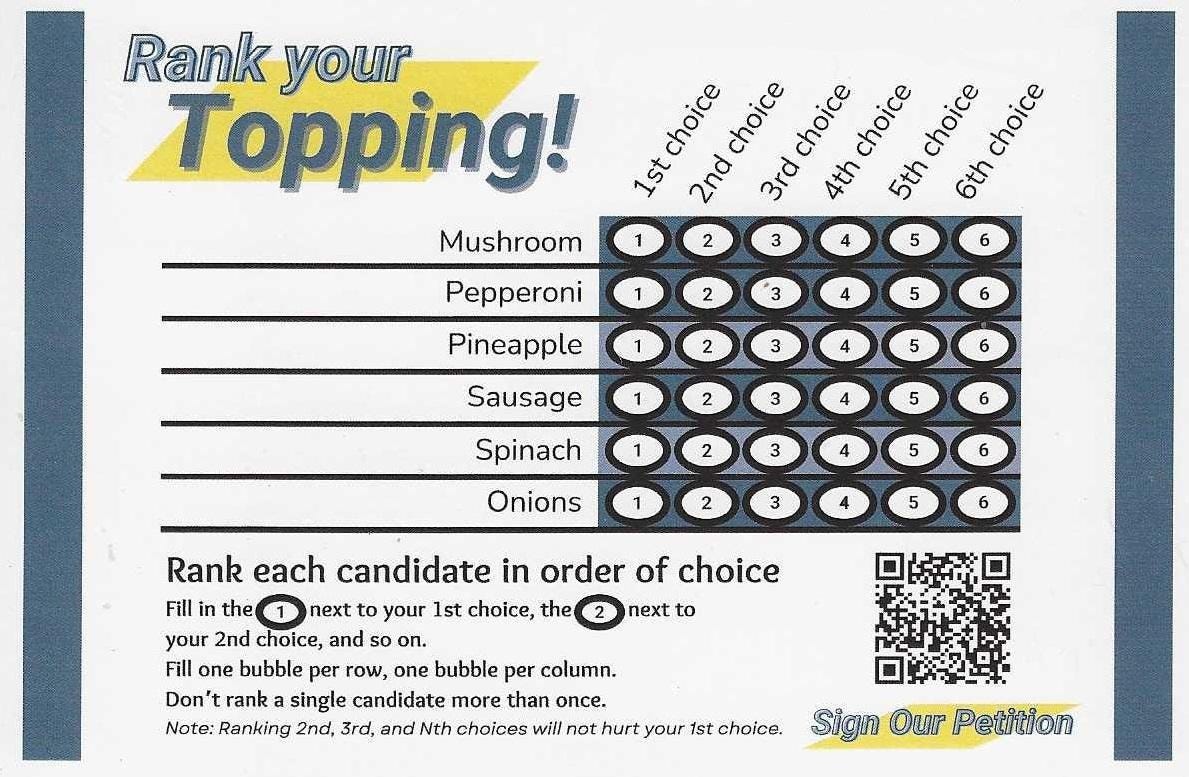
The following ballot graphic is meant to clarify how a RCV ballot is presented to voters and how the counting is accomplished. The graphic shows various candidates which the voter ranks in order of preference. A count of all the 1st preference votes is made to find a candidate with greater than 50% of first place votes. If no candidate earns more than 50% of first-choice votes, the last-place candidate is eliminated, and the “next choice” selections of their voters are redistributed. This continues until a candidate achieves greater than 50% of votes cast.
The Reporter researched articles in opposition to RCV and found that the most common argument used to disparage the voting method relied on citing a RCV election in California that was extremely close and had some mistakes by election officials regarding ballots that were not cast correctly [eg, casting two “#1” preferences]. Advocates point out that any extremely close election can take time to resolve and that electronic voting systems can reduce or eliminate ballot error.
Tara Astor added that, “If the Resolution is put on the agenda and does pass, I want to encourage our state legislator friends, both Republican and Democrat, to support it as well. Then we should do outreach to council members in other nearby municipalities, giving them info on how to write a non-binding resolution to pass RCV to let the state know it’s what we want.”