


As a State of NJ environmental investigator, I had a lot of experience with municipalities. In the very early 2000s, I had the good fortune of meeting Wallington’s Township Clerk. She realized that the State’s interest in reviewing Wallington’s historic landfill files were perfectly aligned with her records custodian interests.
She happily set me loose in Wallington’s file archives with simple instructions: Look through everything. Set aside any ordinance. Throw the rest away.
Those files were amazing. They started somewhere in the late 1800s and contained any kind of subject matter you could imagine. A 1913 dispute with the landfill owner revealed that it started as a sand mine which created a pit so deep and steep that it threatened to swallow Main Street in Wallington. A 1930s letter complained that a neighbor should not be receiving free federal cheese from the Public Works Administration. A 1940’s letter to the mayor asked him to write to a judge requesting mercy for a young man who had gone AWOL. And then there was the 1920’s catalogue from Smith and Wesson and the 1930s catalogue from Harley Davidson. I gave the gun catalogue to Wallington’s Chief of Police. But as amazing as those files were, I was stunned to discover that nobody in state government wanted to preserve any of them. I set aside the ordinances as instructed. I took the files about the landfill. And I reluctantly threw the rest of those historic files into a trash can. They were definitely past their “retention schedule”.

Twenty-five years later and not that much has changed for municipal clerks. They still shoulder the burden of maintaining boxes and boxes of archives. The state imposes archive retention schedules on the Clerks who must abide with requirements to keep contracts, invoices and all manner of legal and financial records.
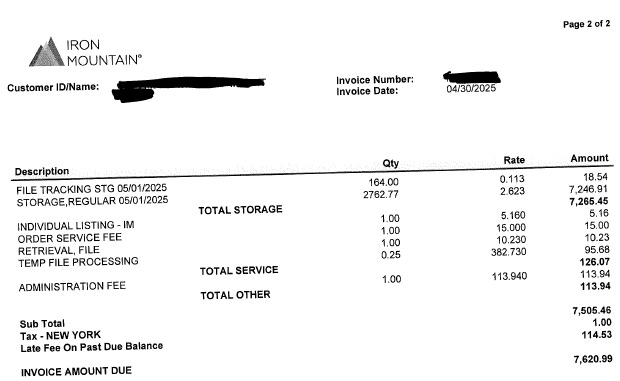
Speaking of financial, The Reporter submitted and Open Public Records Act [OPRA] request to Mount Holly for all 2025 invoices for records storage. The charges are eye watering. The record storage company Iron Mountain is charging Mount Holly Township nearly $8,000 per month to store our archival paper records.
Generally, records storage is charged by the box. Its not clear from the invoices whether Mount Holly is being charged for 2,762.77 boxes or pounds of files. But what is clear is that in May 2025, we had to pay Iron Mountain $7,620.99. The full year of files services cost us $80,100.
As a regular OPRA user and having some professional experience with file digitizing, I understand a good amount about state law on “records retention”. For example, recall the contract for the Township Manager which I requested [see Peek Behind The Curtain]? It should have been retained by Mount Holly for 7 years AFTER it expired. Which means they should still have it. They can’t find it.
As my article “Peek Behind The Curtain” pointed out, Mount Holly has a recurring problem with finding records its required to retain. This doesn’t mean that they destroyed documents, but it indicates that they are not putting enough energy into file management. I confirmed this when I was a member of the Mount Holly Environmental Commission [the Commission no longer exists. It’s a Committee now]. The filing system for environmental documents was a drawer marked “DEP”. Nobody knew what was in that drawer. Was the township legally required to retain all those files or could they destroy some?
This is a very important point for township finances because we need to know: What is Mount Holly doing to make sure that its not burning money to store records that could be tossed? What portion of the $80,000 paid to Iron Mountain in 2025 was for documents that are past their retention schedule? Is it $2, $2,000, or $40,000 worth?
Considering half a million dollars will be paid over the next five years in file storage feels, it seems worthwhile to train a staff member and send them to Iron Mountain to start sorting out the files which can be destroyed. And while they are at it, to create a thorough file database so we know what we have.