


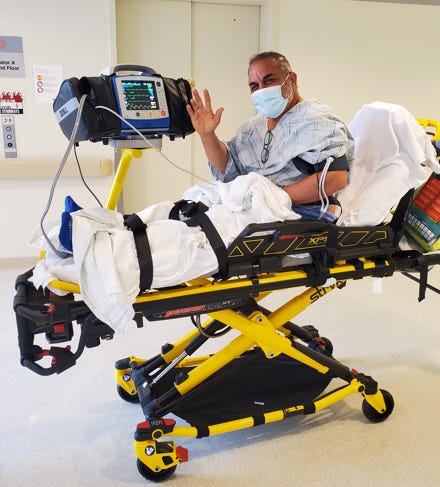
SUMMARY: Last night and into this morning [8/6-7/26] my wife and I once again visited Virtua ER, this time for a obvious/true emergency on her part. We arrived at 9:45 PM, Triaged 10 PM, Blood Draw 12AM, Admitted to ER 2:15 AM, Seen 4 AM, discharged 6 AM with a successful resolution to the emergency. Over 8 hours. Since the bathroom is in another part of the ER, I walked through and every bed I saw was taken, plus gurneys in the hallway with patients. There was a full compliment of nursing staff and service on this date was good as far as nursing goes, BUT THERE WAS ONLY ONE DOCTOR IN THE ENTIRE ER. I confirmed this with two staff who said that this is the NORMAL practice for the overnight shift. So, I believe that I have answered the question at the end of this article. YES, there are a lot of patients, but YES, there is not enough staff. During our stay I watched 1 person walk out who said she had to go to work, and another threatened to walk out, but did not.
During the summer of my 68th year I received an offer I could not refuse: tour medical facilities that treat coronary artery decease -Now.
When you get that kind of offer from the Boss, you do as you’re told.
And so, on July 7th, 2026, I visited the Penn Tower in Philly where a group of medical magicians re-arranged my arterial plumbing and saved my life. I am grateful.
And once you have experienced the well oiled machine that is Penn Medicine, the Virtua Emergency Room seems to be … in need of resources?
To that end, I want to tell you about my visit to the Virtua Emergency Room [ER] on July 29, 2026. But before we go there, lets zoom out and examine what is known about ER’s all over America.
According to “Return On Information — New Jersey” [ROI-NJ.com], the national average emergency room wait time was 2 hours and 42 minutes in 2024, with some hospitals exceeding a 9 hour wait. The longest wait times in New Jersey range from 3 to 5 hours.
THE FOUNDATIONAL PROBLEM: STAFFING RATIOS
Lets revisit the recent dispute that Virtua had with its nursing staff. Just before I received the news that I must undergo surgery, I covered the nurse’s strike story at Virtua. I spoke with a nurse who participated in the demonstrations in Mount Holly. She was very angry about staffing problems and was initially willing to speak on the record. She gave me very specific information. I warned that providing info like that would lead to her identity being discovered even if I withheld her name. Her instinct to keep her job trumped her anger and I did not report what she told me.
But there were others with similar stories. I spoke to a professional who said the undersized staff experience drove her and others she knew out of hospitals. COVID was the event that precipitated her departure, but she said the staffing problem did not start with COVID and has persisted long after the pandemic.
"Nurses have been choosing to leave hospitals due to stressful and unsafe working conditions, including poor staffing.” HPAE President Debbie White, RN
The good news is that the Health Professionals and Allied Employees union (HPAE), won contractually enforceable staffing ratios in many of the Virtua units such as
Critical Care – 1:2
Med/Surg – 1:5
Progressive Care Unit (Step Down)– 1:4
Behavioral Health – 1:6
Unfortunately, the Emergency Department and Maternal Child Health units did not get enforceable ratios in the contract.
Every medical professional I have spoken with including doctors and nurses have uniformly said that staffing problems leave hospitals in a position of struggling with patient census.
NON-EMERGENCIES AT THE ER
The other half of the staffing ratio problem is the number of people who visit an ER who are not actually experiencing a medical emergency. Some of these people do not have medical insurance and use ER’s as the most accessible way of getting medical attention. Others [like me] find themselves in a situation where an issue arises at a time when they cannot contact their doctor. Since they do not have the medical expertise to distinguish an urgent issue from an emergency, they err on the side of caution and go.
EMERGENCY ROOM HALLWAY CHOKED WITH PATIENTS
Last Wednesday, July 29th 2026, I noticed what looked like an infection at my calf surgery incision. This issue arose at 12 AM when a call to the to the Penn surgical team that is still covering me was not possible. Not wanting to give an infection a 10 hour head start, I decided to visit Virtua ER. I figured they could give me an antibiotic and send me home. That was not to be.
I sat in the waiting room for two-plus hours and watched EVERY other triaged patient get admitted to the back. Mercifully, the ER staff finally called my name some time around 3 AM and I left the waiting room completely empty.
Looking back on it, the only seemingly plausible theory Google AI offered to explain why ER staff might want to move all triaged patients from the waiting room, past the triage desk and into the back was so doctors and nurses could more closely monitor them.
But Virtua is not like the fictional open floor plan in “The Pitt” medical show. Virtua’s ER halls are walled off and on this night were choked with patients in chairs and laying on gurneys with blankets draped around them. It also did not resemble “The Pitt” in terms of having lots of visible medical staff. Staff on the floor seemed to be a scarce resource.
During the half hour or so that I sat waiting for attention, I saw only one Virtua staff member circulate amongst the patients. She made a tricky zig-zag maneuver of a patient on a gurney through the crowded ER hallway.
A LACONIC RESPONSE
I get the brutal logic of Triage: “do the worst first”. That’s how I knew that being called last meant my case was ranked as a low triage priority.
I noticed three staff staring at monitors behind their COVID-era transparent barrier. No staff addressed the patient throng as a group or came to us individually to explain what was happening or how long we might wait.
One patient in the hallway who I recognized from the waiting room got up to announce he was leaving. A staff member called out from behind the COVID barrier saying it would be a shame to have waited all this time only to leave before you got service. The person sat down.
At some point beyond my third hour I reckoned that Virtua would not get to me before the sun rose on Thursday. So I decided to cut my losses, take my chances with a possible infection and get some sleep at home.
I stood up and approached the COVID glass barrier saying to the staff that I can’t wait any longer. I vainly hoped a staff member might tell me that help was on the way.
They said nothing.
Once I exited the ER, I passed through the now empty waiting room and saw the nurse who triaged me over 3 hours earlier. He was having a meal and looked at me dispassionately. I said that I couldn’t wait any longer. He diverted his gaze and said laconically, “Busy night”.
THE QUESTION REMAINS
I don’t have the census data on Virtua’s ER. But my wife accompanied me on this adventure and recalled her visit to the same ER early in the year. She said it was way busier on that previous night.
Based on the comments [mentioned above] from nurses during what I call “the Strike”, I know that many medical professionals are disgusted with a lack of staff and that this has driven many of them out of the hospitals.
However, the impression I got from the ER staff was that they have accepted hours upon hours of waiting for medical care as the natural order of things.
So, was the number of patients more than usual or was the number of medical staff less than usual, or both? If any nurses or doctors want to tell me, please feel free to contact me at nick.sodano@verizon.net.